
NC SAVAN Coverage in Clay County
North Carolina Statewide Automated Victim Assistance and Notification is known as NC SAVAN and is also accessed through VINELink. Official state material describes it as free and anonymous to the offender. It receives custody information from NCDAC and is also used by North Carolina county jails. That statewide statement supports searching for a Clay County Detention Center record, but it does not guarantee that every person or past event remains visible.
NC SAVAN performs two related jobs. It can display a custody status supplied by an agency, and it can deliver notice of a later event. It is not a certified jail record, court file, or full history of every Clay County arrest. The web route is VINELink, and telephone access is available at 1-877-627-2826.
Search a Clay County Inmate on VINELink
Begin with the last known custody system and enough detail to distinguish the person. A Clay County arrest does not prove that the person remained at the local jail. They may have entered NCDAC, another county, federal custody, immigration custody, a medical setting, or the community. VINELink helps with participating jail and state events, not every branch of that chain.
- Open VINELink and select North Carolina before entering a person’s information.
- Search by the offender identifier when known. Otherwise, enter the name fields the interface offers.
- Review each plausible match rather than choosing the first similar name.
- Compare offender ID, name, age or other demographics, facility, and event details before opening or saving the result.
- Read the literal custody description. Do not translate “transferred,” “out to court,” “escaped,” or another non-housed label into community release.
- If no reliable result appears, call the Clay County Detention Center or search NCDAC OPI according to the last known custodian.
The Clay County released-inmate lookup supplies the wider fallback chain when the person cannot be confirmed through NC SAVAN. The key is to follow the destination, not infer release from an empty result.
What Clay County VINELink Shows
The record reflects data supplied by the participating agency and may differ by custody system. Save the exact label and event time shown. A released result may say “released” or “no longer in custody” and may include an agency-supplied date. That wording is stronger than mere absence, but the source agency remains the best place to confirm the physical event.
| Field | How to read it |
|---|---|
| Name and offender ID | Use both to distinguish the Clay County person from a namesake. |
| Custody status | Preserve the literal words; released, transferred, and escaped describe different events. |
| Facility or location | Shows the supplying or current agency context, which tells you where to verify. |
| Event type | Identifies the custody change offered for search or notification. |
| Event date and time | May be supplied by the agency, but timing can lag the operational event. |
| Notification options | Shows which future events and delivery methods the current record offers. |
A status that says released from Clay County can still mark only the end of local custody. If the destination is NCDAC, another jail, USMS, ICE, or a medical provider, confinement may continue. Ask the detention center whether the event was release to the community or transfer.
For a state record, compare VINELink with the NCDAC offender detail. An active inmate status and prison location point to continued state confinement. An Actual Release Date paired with Active Probationer-Parolee can mean the person left prison and entered community supervision. An inactive NCDAC status can support the end of the tracked state episode, but it does not establish what happened in a later Clay County booking.
Clay County VINELink Search Screen
The official VINELink interface is the correct public starting point for North Carolina. The manifest capture below illustrates the state-selection and person-search route without presenting private subscriber information.
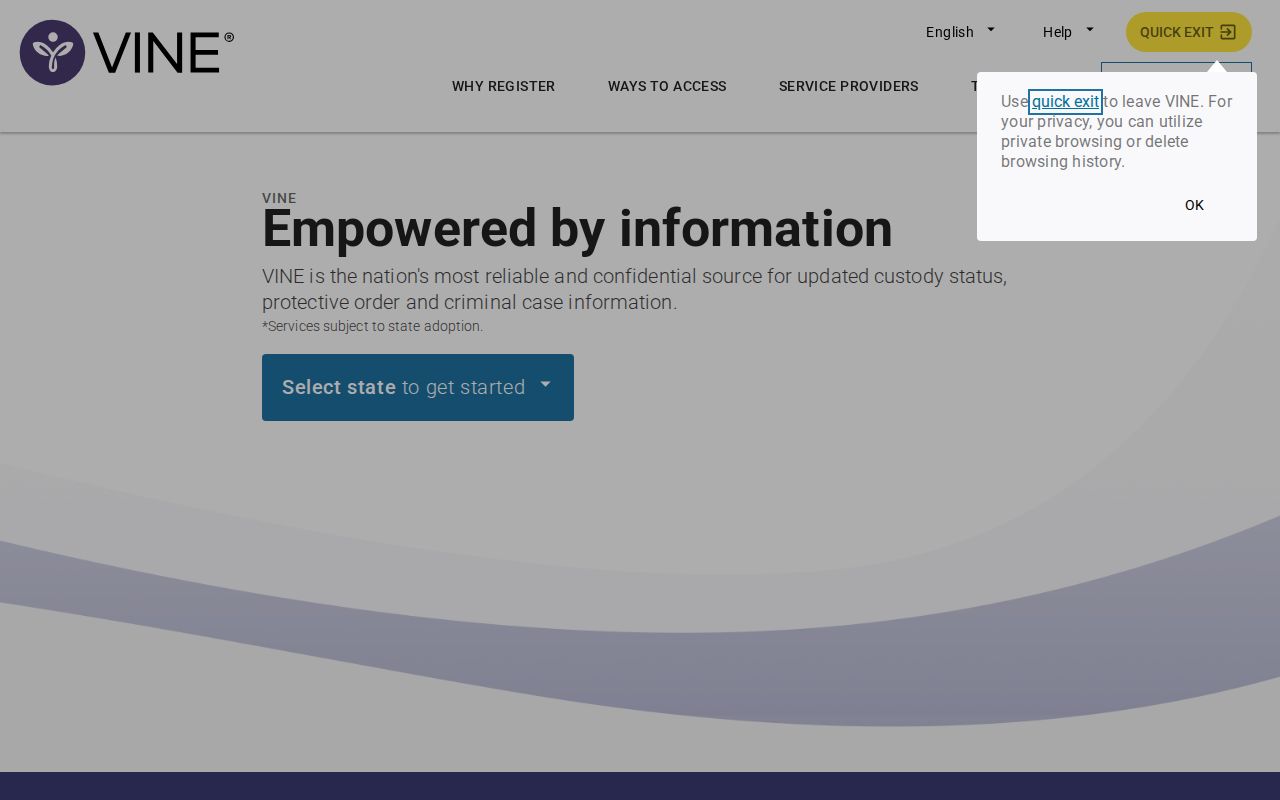
Use the live interface because fields and delivery choices can change. The screenshot is a guide to the channel, not evidence about any named person’s current status.
Register a Clay County Release Alert
Registration begins from the correctly matched person record, not from a general county page. The offered events and delivery methods can depend on the agency and record. Current options may include telephone, email, text, or TTY. Keep delivery details and any PIN private.
- Open the matched offender record and choose “Get Notified” or the equivalent action.
- Select the custody event and delivery method offered for that record.
- Enter and verify the phone number, email address, text destination, or TTY information requested.
- Create or record the confirmation and PIN where the system prompts for one.
- Retain the registration confirmation so the subscription can be checked later.
- For a phone notice, answer and enter the PIN to acknowledge receipt.
NCDAC’s published policy says telephone calls repeat at set intervals for twenty-four hours when the PIN is not entered. That behavior helps explain repeated calls, but it should not be used to infer multiple custody events. One alert must still be read by its event wording and verified with the supplying agency.
Registration should be tied to the correct offender identifier whenever the interface provides one. If two people share a name, compare age, facility, physical details, and agency context before entering contact information. Save the confirmation apart from the PIN and update the delivery route if a phone number or email address changes. A failed delivery does not mean that no event occurred.
Verify a Clay County Release Alert
Write down the exact event phrase, date and time, facility, and offender ID before calling an agency. For a Clay County Detention Center event, use the official detention page, call 828-389-8207, and ask whether the departure was to the community or a named receiving custodian. For an NCDAC event, inspect OPI and contact NCDAC if the public entries conflict.
A court docket can explain a dismissal, bond action, judgment, or sentence, but it does not prove the moment jail staff cleared all holds and completed departure. Likewise, OPI can preserve an Actual Release Date while also showing active post-release supervision. Describe both facts. Do not collapse actual release, supervision start, and supervision end into one date.
Clay County Notification Channel Roles
Clay County has no verified public historical release roster, so NC SAVAN is useful as a prospective notification layer. It is not the same as the county’s booking-and-release record. The detention center record can supply the physical release time and, when public, the release authority or transfer destination. The NCDAC OPI search supplies the durable state trail for prison, sentence, actual-release, and community-supervision entries.
The North Carolina Sex Offender and Public Protection Registry is a separate system for people with reportable convictions. Registry presence shows a continuing registration duty, not the time or manner of a Clay County jail release. It does not cover most released people and should not be searched as a substitute for VINELink.
These channels work best in sequence. Use NC SAVAN for notice, the custodian for release confirmation, NCDAC OPI for state history, and the Clay County court source for legal context. If the systems disagree, keep each source’s exact language and ask which agency owns the disputed event.
For a missing Clay County result, begin with the detention center because no verified county historical roster exists. Provide the full legal name, date of birth if known, booking or case number, and approximate event date. Ask whether the person remains housed, left for the community, or transferred. If staff name a destination, search that receiving system rather than repeating a broad VINELink name query.
Clay County VINELink Limits
Names can collide, source data can lag, and a historical Clay County release may no longer be searchable. The precise wording and retention of a released Clay result were not tested with a real subject, so no fixed display period should be promised. Registration is described as anonymous to the offender, but a subscriber should still protect delivery addresses, confirmations, and PINs.
Telephone access is useful when the web interface is unavailable, but the same identity and event checks still apply. Note the number called, query time, matched identifier, and exact response so a later agency confirmation can be reconciled with it.
VINELink is not the locator for a federal prisoner. Use the Bureau of Prisons Inmate Locator for a sentenced federal person, and remember that USMS can control federal pretrial custody even when someone is housed in a county jail. ICE maintains its own current-location system with coverage limits. No result from any one locator proves community release.
A BOP result with a past release date and Released location establishes departure from BOP custody, not freedom from all government control. A federal person may enter supervised release or another agency’s custody. Likewise, an ICE locator miss can reflect transfer, delay, excluded coverage, or an older event. Those systems do not become part of NC SAVAN merely because the person was once physically held in Clay County.
Do not rely on NC SAVAN as the sole safety plan or as a certified government record. If the event is consequential, confirm it directly with Clay County Detention Center or NCDAC and retain the official response. For a person still shown at a facility, treat the status as current custody information, not a past release record.
For a durable research note, save the query date, system name, page title, matched identifiers, literal status, facility, and event time. Dynamic result links can later return a blank search form. A screenshot may document public fields, but it should never expose a subscriber’s phone number, email address, confirmation code, PIN, or unrelated personal data.
Public Record Search
Sponsored Results